Beyond Care · Digital Tool
Nobody sees how much you do. This makes it impossible to ignore.
14 pages. Five dimensions. Every task, every worry, every invisible thing you carry, finally on paper. One-time purchase, yours forever.
BEYOND CARE · DIGITAL TOOLKIT
"No one could see everything I carried. Now it's on one page."
A BEYOND CARE TOOLKIT
The Care
Load Map
Make the invisible load
impossible to ignore.
BEYONDCARECO.COM
14-page fillable PDF · works on any device
A peek inside
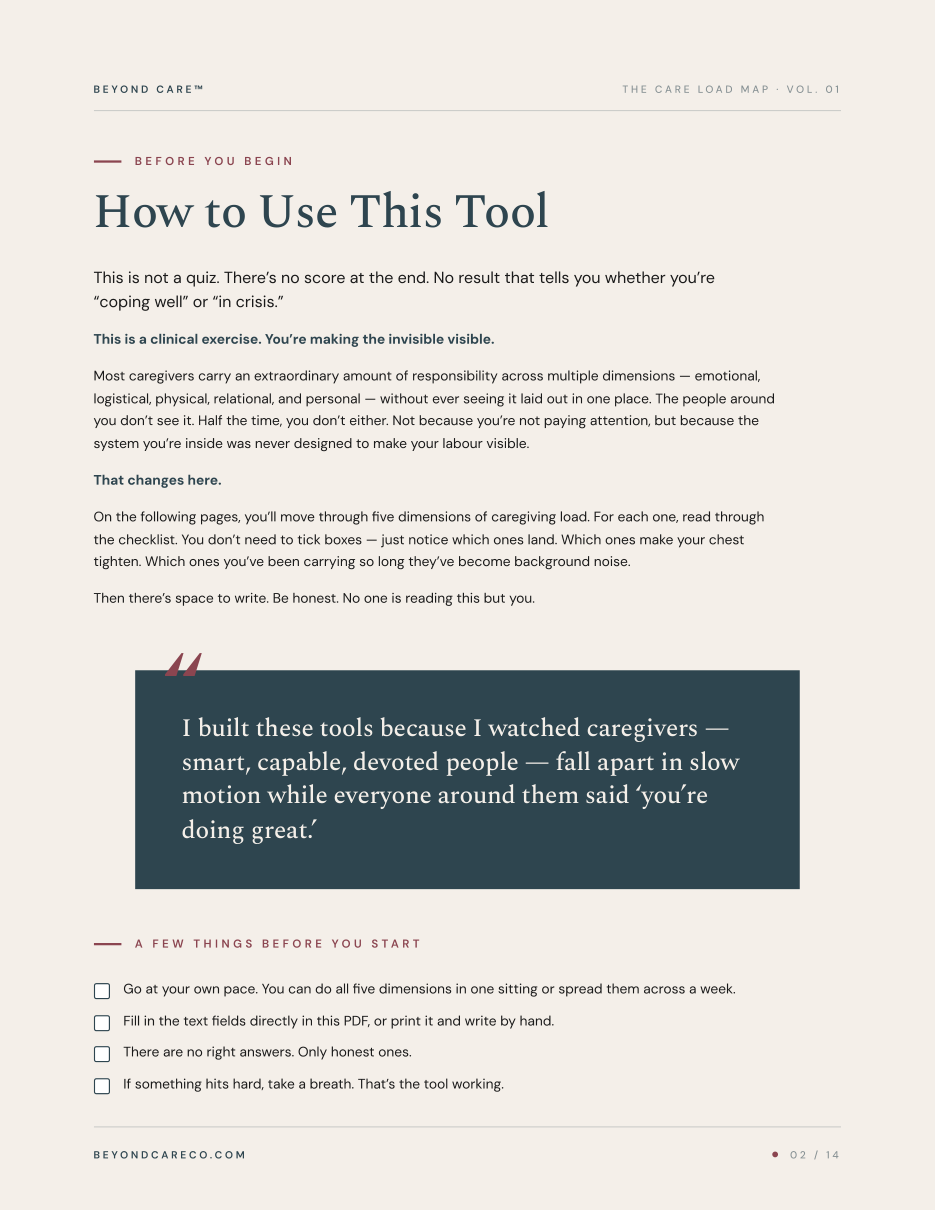
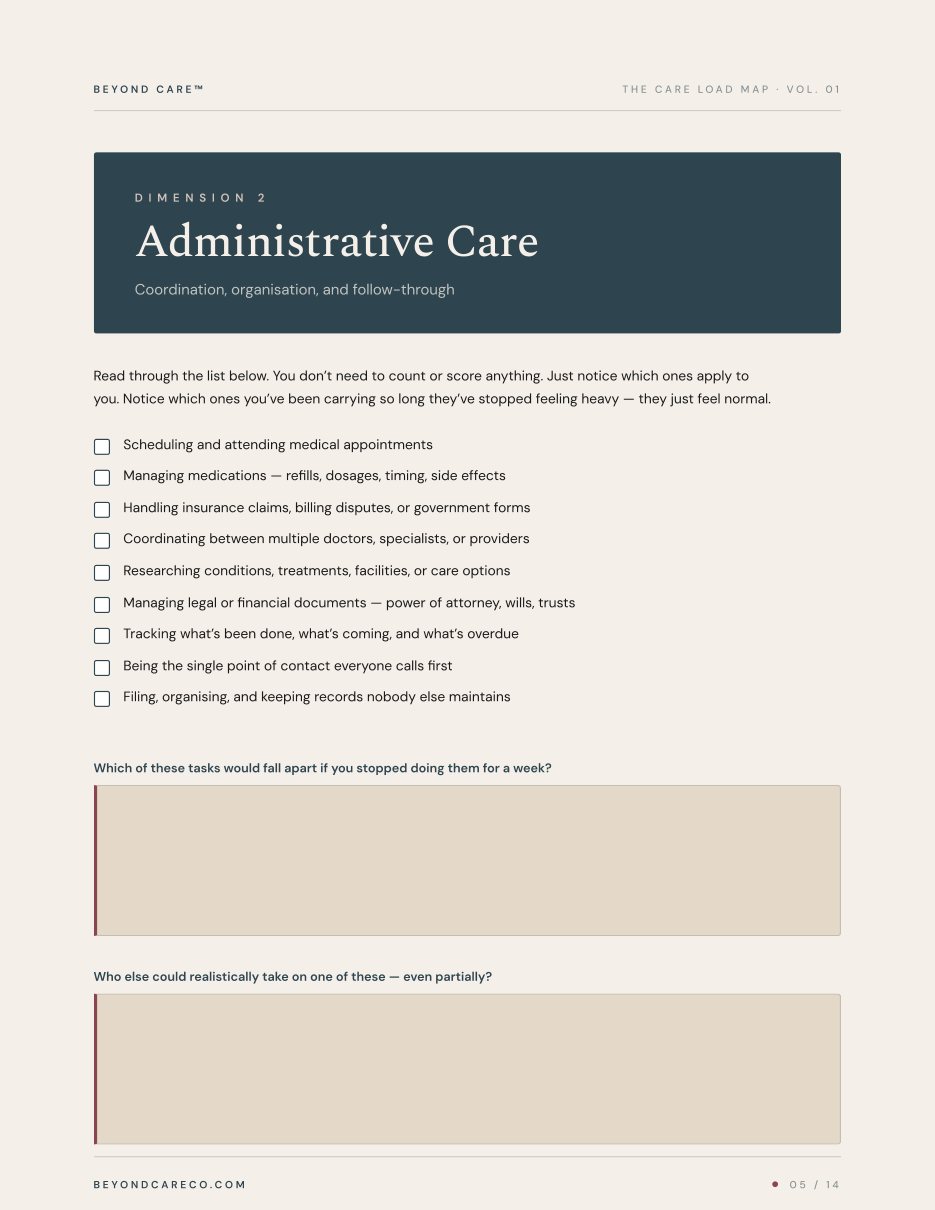
A clinical exercise, not a quiz. Walk through five dimensions of caregiving load — emotional, logistical, physical, relational, identity — and finally see the shape of what you're holding.
You can't change a system you can't see.
You know you're carrying too much. The appointments, the medications, the emotional check-ins, the things you notice that nobody else does. Someone else's entire life, running in the background of yours.
But if someone asked you to list exactly what you do? You'd struggle. Not because you don't do enough. Because you've never mapped it.
The tasks, the coordination, the emotional weight, the medical stuff, the money stuff. Every category of care you're carrying, on one page.
When you see the full picture, you understand why you're exhausted. It's not weakness. It's volume.
Show a sibling, a spouse, a therapist, a care coordinator. No more explaining. No more defending. Just the map.
Once you see everything, you can start spotting what someone else could take on, what could be let go, and where to ask for help.
One-time purchase. PDF download. Use forever.
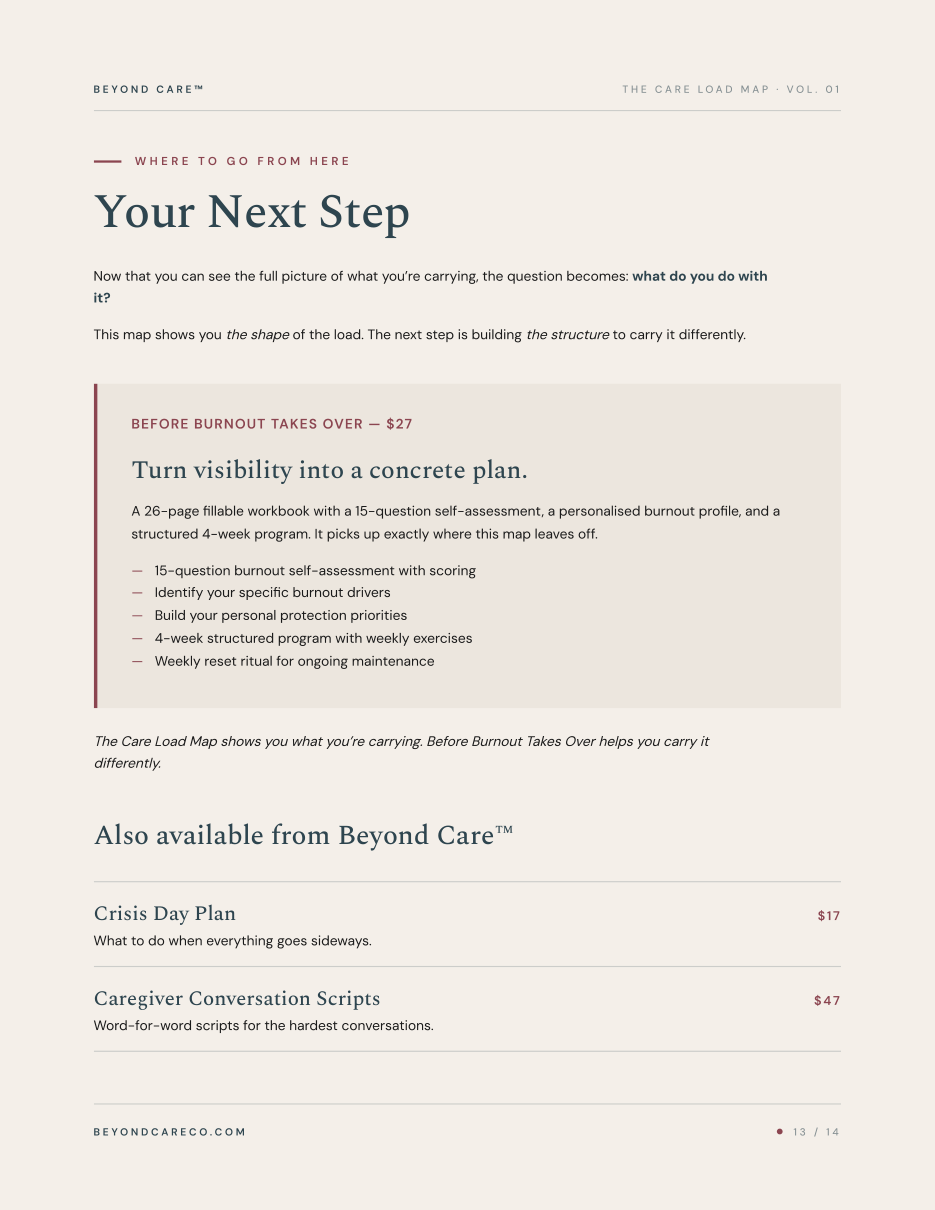
Plus, included
Five hand-it-to-someone pages, included. One for each dimension: Emotional, Logistical, Physical, Relational, Identity. You stop explaining the weight every time. You hand it over.
The page you give to your sister. The page you bring to the family meeting. The page you take to your therapist. They are built into the toolkit.
Before:
You are tired in a way sleep does not fix.
You can list ten things you did today, and you still feel like nothing got done.
Your sister texts asking what you have been up to and the question lands wrong.
You don't know how to answer because you can't see the shape of what you are holding.
After:
You spend 20 minutes filling in five pages.
You see, in writing, the emotional load, the logistics, the medical coordination, the identity stuff, the relational labour.
You realize why you are tired.
It is not weakness. It is volume.
You hand the Share Page to your sister at dinner.
She reads it.
The conversation is finally different.
Why I built this
I'm Kylie. Master of Social Work, twelve years of clinical work with caregivers, and the granddaughter who watched a family try to hold things together when my grandmother was diagnosed with dementia.
What I saw most often wasn't burnout in the textbook sense. It was a slow loss of self that nobody named because nobody had a way to see it. The Care Load Map is the first time I've seen that mapping work in 14 pages instead of an entire intake session.
If you can see what you're carrying, you can ask for what you actually need.
A to-do list tracks tasks. The Care Load Map captures the full picture, including the emotional labour, the mental load, the coordination, and the invisible work that never makes it onto a list. It's not about getting more done. It's about seeing what you're already doing.
Whatever you need. Keep it for yourself as a reality check. Bring it to a family meeting. Show it to your therapist. Hand it to the sibling who "didn't realize how much you were doing." It's your document. Use it however it helps.
That's a real concern. The load you're already carrying tends to get smaller when you can see it, not bigger. Carrying it invisibly is what makes it crushing. Carrying it on paper is what makes it negotiable.
Then it's still useful for you. The Map isn't only for sharing, it's also a reality check. If you've been gaslit into thinking you're not doing that much, the Map is the proof. Show it to a therapist, a care coordinator, or just yourself. Sometimes the most important person who needs to see what you're carrying is you.
No. It's a clinical exercise built from intake-session frameworks, but it's a tool, not a treatment. If you're in crisis or burnout, please call or text 988 (US/Canada) or talk to a therapist. The Map can support that work, not replace it.
The Care Load Map is the first step in the STEADY Method: See the System. Before anything changes, you have to see what you're carrying.
Created by Kylie Goldman, MSW.
Sneak peek · A full Share Page
Share Pages are the differentiator. One per care category. You stop explaining the weight every time. You hand it over.
That's one of five Share Pages. The others cover Logistical, Physical, Relational, and Identity load. Yours for $7.
$7
14-page fillable PDF · Five dimensions of caregiving load
Share Pages you can hand to family, therapists, care teams
One-time payment. No subscription. Yours forever.
The Map is here for the moment you need to look at all of it on one page. That moment doesn't always come on demand.