Beyond Care · Digital Guide
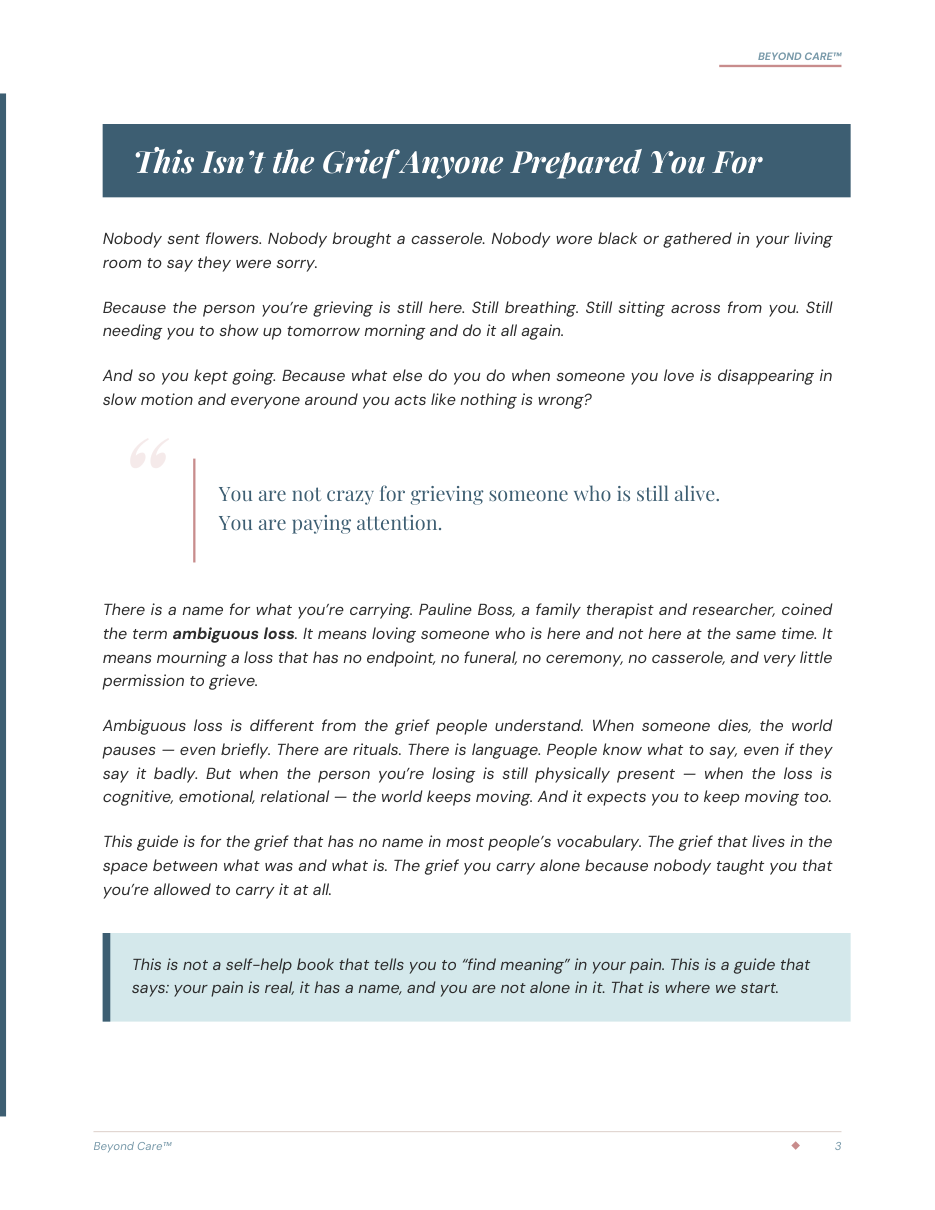
Nobody sends flowers for the kind of loss you're carrying.
You're mourning someone who's still here. The parent you knew is fading, slowly, unevenly, in ways nobody around you fully understands. This guide was built for that exact loss. One-time purchase, yours forever.
BEYOND CARE · DIGITAL TOOLKIT
"They're still here. So why does it feel like grief?"
A BEYOND CARE TOOLKIT
Grieving Someone
Who's Still Here
For the grief that
has no funeral.
BEYONDCARECO.COM
18-page fillable PDF · works on any device
A peek inside
Anticipatory grief. Ambiguous loss. The slow erosion of someone who's physically present but psychologically gone. Named clearly so you can finally feel it without apologising for it.
The grief that has no funeral, finally given a name.
$37 · Digital Guide
Your parent is here, but not the way they used to be. You're mourning someone you still take care of every day. Nobody sends flowers. Nobody brings meals. There's no ceremony to mark what you've already lost.
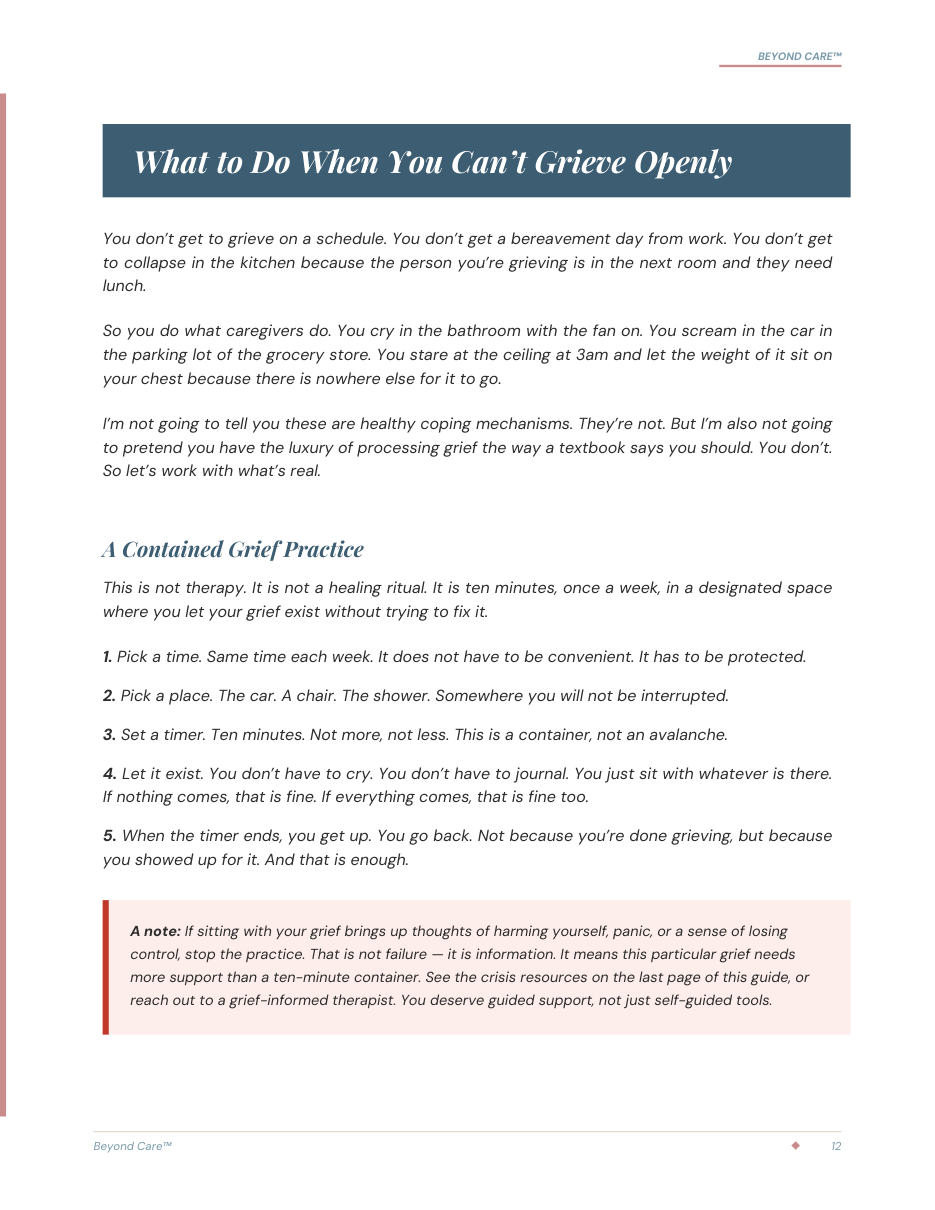
This guide helps you name what's happening, understand why it hurts the way it does, and hold both grief and love at the same time, without pretending either one away.
The shape of grief our culture knows is "someone died, time passes, you move on." That shape doesn't fit when your person is still here. This is the framework that does, ambiguous loss, named clearly so you can stop apologizing for what you feel.
The grief of who they were. The grief of your future. The grief of your relationship. The grief of being unseen. The grief of anticipated death.
A guided exercise to put words to the specific losses you're carrying. Not vague journaling. Specific, honest, and yours.
Bonus, included free
You are allowed to grieve someone who is still alive. You are allowed to miss who they were. You are allowed to not be okay. Read them slowly. Let them land.
One-time purchase. PDF download. Use forever.
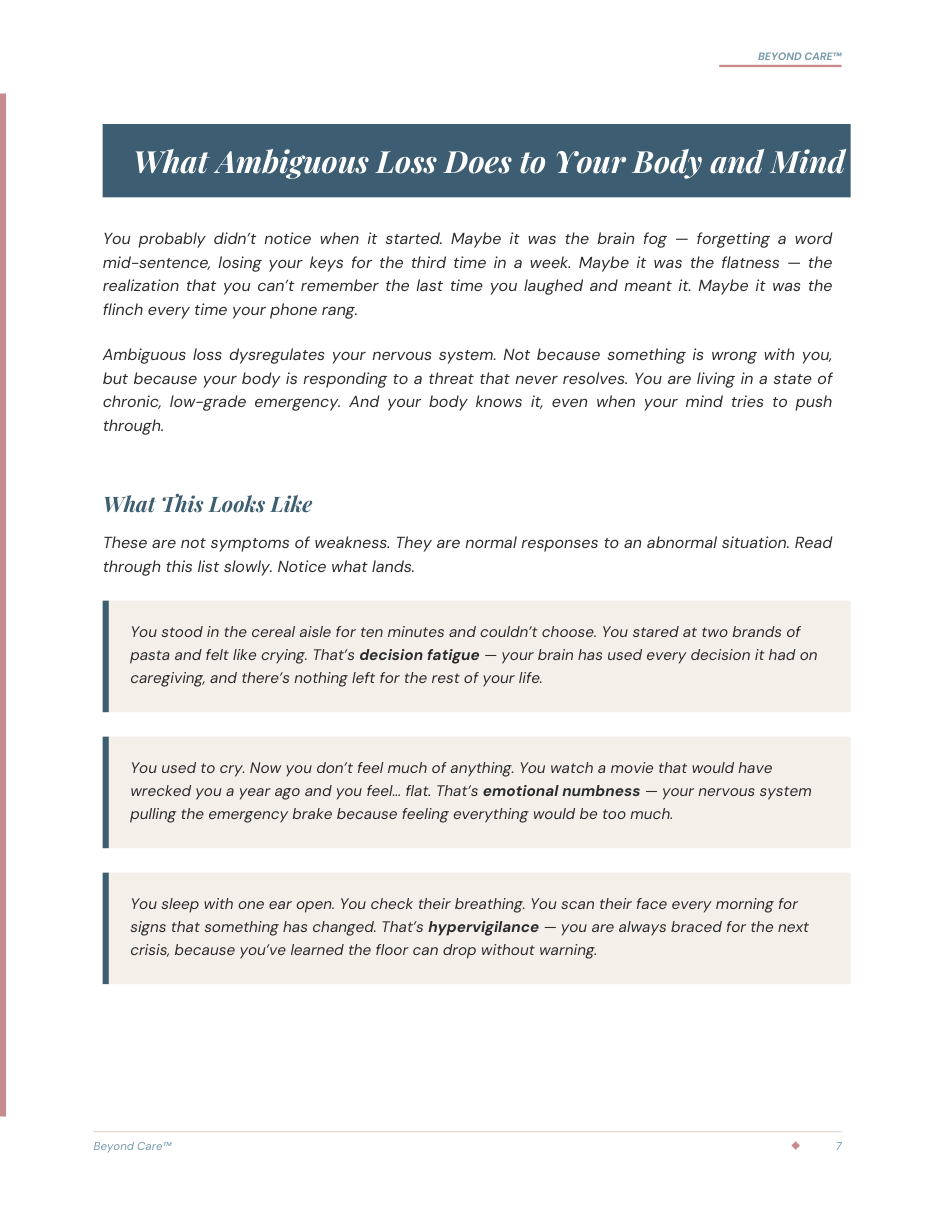
Before: You feel a kind of grief you can't explain. Friends say "but they're still here, you should be grateful." Family says "stop being morbid." You stop talking about it. The grief goes underground and comes back as exhaustion, resentment, the slow disappearance of who you used to be.
After: The grief has a name. Anticipatory loss. Ambiguous grief. The Five Griefs caregivers carry. You read it. You recognize yourself. You stop apologizing for what you're feeling. You hold both grief and love at the same time without pretending either one away.
Why I built this
I'm Kylie. Master of Social Work, twelve years working with caregivers, and the granddaughter who watched my grandmother Phyllis fade slowly through dementia.
What I noticed most often wasn't the moment of loss. It was the slow erosion before, the version of her that disappeared a piece at a time, while she was still in the room. My grandfather, my mom, my aunt, they were all grieving someone who was technically still alive. And nobody had a name for what they were going through.
This guide is the conversation I wish someone had handed them. Not because it would have made the grief easier. Because it would have made it legitimate.
You're allowed to grieve someone who's still here. This guide says it. So that you can.
No. Ambiguous loss happens whenever someone you love is still physically present but psychologically or emotionally changed: dementia, brain injury, addiction, severe mental illness, stroke. If you're grieving someone who's still alive, this guide is for you.
It's a guided reflection: part education, part exercises, part permission. There are fillable sections where you name your specific losses, but it's not a traditional journal. Think of it as the conversation you needed to have with someone who actually gets it.
It might make you cry. Not because it's sad. Because it's honest. Naming grief tends to make it lighter, not heavier. When something has a name, it stops being a shapeless weight on your chest at 3am.
Yes. The Five Griefs framework and the Permission Statements apply equally to grief after death, especially when the person you cared for declined slowly. The grief that started while they were still here doesn't end when they go. This guide is for both.
No. The framework is grounded in clinical concepts (ambiguous loss, anticipatory grief) from family systems and grief research. There's no religious or spiritual orientation in the language. Use it alongside whatever framework you already hold, or none.
Written by Kylie Goldman, MSW, who understands ambiguous loss clinically and personally. A granddaughter who watched it happen, and a social worker who's walked alongside families living it.
Sneak peek · A few Permission Statements
Permission Statements often land first. Eight of them, in full. The rest are yours after checkout.
Eight of the Permission Statements in the toolkit. The rest, plus the Five Griefs framework and the guided naming exercise, are yours for $37.
And those are not the same thing, no matter how many times the world has confused them.
$37
Fillable digital PDF · Ambiguous loss education
Guided reflections · Permission statements
One-time payment. No subscription. Yours forever.
I wrote this for the version of me who needed someone to name what I was going through. It's here whenever you need that too.